- Swaybars couple the left and right sides of a car's suspension
- Effectively adds spring rate to the springs when turning, dependent on the thickness and stiffness of the bar
- Bigger swaybar at the front/smaller bar at the rear provides more grip to the rear, reducing oversteer
- Smaller swaybar at the front/bigger bar at the rear provides more grip to the front, reducing understeer
- This is due to the transfer of lateral grip between the front and rear ends of the car and increase in motive grip (accelerating out of a corner). In terms of a FWD car:
- When you turn hard into a corner and you start understeering, it is because the car is leaning too hard on the outside wheel, reducing the weight on the inside wheel, losing traction. Solution is to either:
- Reduce the front swaybar size (effectively reducing the coupling effect between the left and right side of the front suspension, allowing the front wheels to gain more traction)
- Increase the rear swaybar size (effectively increase the coupling effect between the left and right side of the rear suspension, thereby transferring some of the weight towards the front, most importantly the inside wheel)
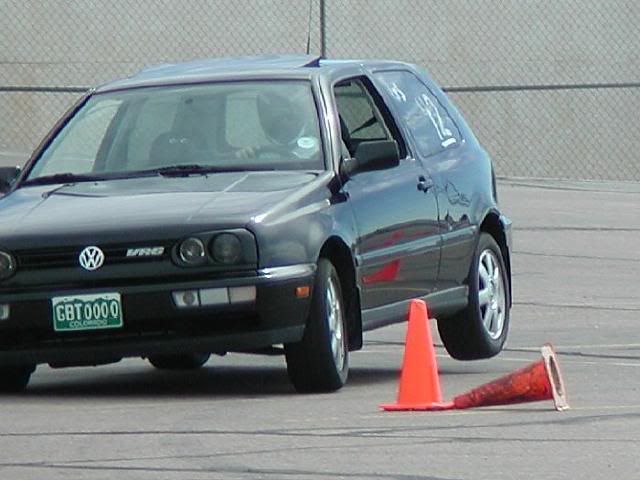
Mk3 cocking the inside rear wheel - in part due to either a bigger rear swaybar (pushing the weight towards the front) or smaller front swaybar (allowing the inside front wheel to maintain traction), or both.
Most VWs/Audis come with front swaybars but no rear swaybar (though there is a chunky torsion beam in the Mk4s/8Ls). This is in part a safety feature, seeing as safety is priority number one and an understeering car is more desirable than an oversteering one in the case of an accident.
A common upgrade for enthusiasts is to increase the swaybar size for the front and rear. In real world terms, this would stiffen up the ride, especially when negotiating corners. Realistically, a rear swaybar would suffice in providing much improved handling characteristics for FWD VAGs. Many autocrossers even remove the front swaybar in an effort to gain faster times by increasing lateral and motive grip, as mentioned previously.
This car runs stiff springs, no front swaybar and an aftermarket rear swaybar. Note the lack of understeer while cornering hard.
Which brings me to the main reason why I decided to write about this topic - do I need my front swaybar? Reason I ask is that with the Mk4/8L platform, the swaybar is designed and attached in a way that causes it to hit the driveshaft when the car is lowered (due to the driveshaft angle sloping upwards as the car is lowered). Strangely, it's a design where the swaybar link is attached to the control arm and the swaybar itself loops over the driveshaft before lining itself on the subframe. Fortunately though, there have been many aftermarket swaybar links that are extended or adjustable, providing the extra clearance a lowered Mk4/8L requires. A more expensive alternative is to go for an aftermarket swaybar with a revised design (I think the 4Motion one works too... but not sure). That said, for a Mk4 to lay frame on airride, you're better off remove the sway bar all together. And of course, my goal is for the 8L to be able to lay frame :P
So I've searched around and found the following comments about removing the front swaybar:
- Not much difference (most layman comments)
- Improved front grip in corners, but "squirrelly" transitions from side-to-side and delayed reaction to driver input; essentially a compromise of gaining cornering grip for the car feeling "tight" (from an experienced autocrosser)
- "I removed my front sway bar and am running a Peloquinn with KW V1's, ABSOLUTELY FANTASTIC for street!!!"
- "Snap oversteer". May drive without much change but when it decides to give, it suddenly does so and will catch inexperienced drivers by surprise.
- Less noticeable difference if coupled with a stiff (but still steetable) suspension setup.
http://www.houseofthud.com/cartech/swaybars.htm
http://www.airsociety.net/forums/showthread.php/940-Swaybar-endlink
http://forums.vwvortex.com/showthread.php?4451107-removing-front-sway-bar-MK4-golf